
Nectarine Cupcakes – Flight Behavior
This discussion of Flight Behavior by Barbara Kingsolver requires a light, sweet concoction. These nectarine cupcakes—with their fruity cake and light-as-air whipped topping—are a perfect solution. The touch of honey, hint of rum, and ripe nectarines create a delightful treat for your next book club discussion.
Nectarine Cupcakes
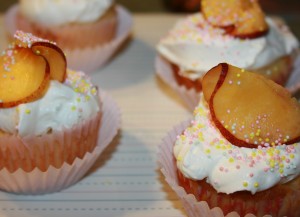 Modified from Martha Stewart Living, August 2010
- 1-1/4 cups flour
- 3/4 cup sugar
- 1/2 teaspoon baking powder
- 1/2 teaspoon salt
- 1/3 cup milk
- 1 teaspoon rum extract
- 1 Tablespoon honey
- 6 Tablespoons butter, room temperature
- 2 eggs
- 2 nectarines, peeled, halved, pitted, and finely chopped ( approx. 1 1/4 cups)
Preheat oven to 350 degrees. Add cupcake liners to a cupcake pan. Makes 18 cupcakes.
Beat butter and sugar with a mixer on medium speed for about 3 minutes. Beat in eggs, one at a time.
Add rum extract, honey, baking powder, and salt. Finally add flour and milk, alternating. Mix until incorporated without overmixing.
Fold in the finely chopped nectarines. Divide batter into muffin tins.
Bake at 350 degrees for approximately 25 minutes. Let cool thoroughly. Cupcakes taste best chilled.
Fresh Whipped Cream Topping
- 1 cup cold heavy cream
- 1/2 cup sour cream
- 3 Tablespoons sugar
- 1/2 Teaspoon rum extract
- 1 nectarine, halved, pitted, and very thinly sliced, for garnish
HINT: Put your bowl and/or mixer attachments in the freezer before making the topping. It will speed the process.
Beat together cream, sour cream, and sugar to medium peaks on high speed. Right before serving, top cupcakes with a dollop of cream and nectarine slices.
If you add sprinkles (as pictured), they bleed colors if left too long due to the moisture. The topping is best if added to cupcakes right before serving. You can store the whipped topping in the refrigerator for up to a day. Just stir it vigorously before using to reincorporate.
These butterfly-kissed cupcakes could also be decorated with cute butterfly cupcake toppers, edible flowers, or colored sugars. They are a charming summertime treat as well as book club treat.
May words nourish your soul.
Flight Behavior – Discussion Questions
Barbara Kingsolver’s book, The Poisonwood Bible, is one of my top five favorite books ever. The complexity in her writing is astounding, touching on religious beliefs, socioeconomic class structure, environmental concerns, and human nature. Flight Behavior by Barbara Kingsolver is no different. It is a rich, picturesque novel about poverty, everyday miracles, and lost causes.
Synopsis
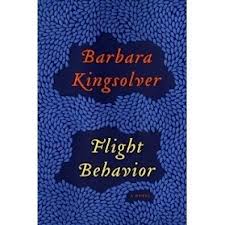 Set in the present day in the rural community of Feathertown, Tennessee, Flight Behavior tells the story of Dellarobia Turnbow, a petite, razor-sharp 29-year-old who nurtured worldly ambitions before becoming pregnant and marrying at seventeen. Now, after more than a decade of tending to small children on a failing farm, oppressed by poverty, isolation and her husband’s antagonistic family, she has mitigated her boredom by surrendering to an obsessive flirtation with a handsome younger man.
In the opening scene, Dellarobia is headed for a secluded mountain cabin to meet this man and initiate what she expects will be a self-destructive affair. But the tryst never happens. Instead, she walks into something on the mountainside she cannot explain or understand: a forested valley filled with silent red fire that appears to her a miracle.
After years lived entirely in the confines of one small house, Dellarobia finds her path suddenly opening out, chapter by chapter, into blunt and confrontational engagement with her family, her church, her town, her continent, and finally the world at large.
-From Harper Collins
Discussion Questions
Harper Collins has a wonderful selection of brilliant questions for discussion. Consider the following additional discussion questions for your book club:
- “Southern Appalachian culture, [Kingsolver] says, is “mostly derided in the world—hillbillies are one of the last ethnic groups who are routinely mocked without consequence.” (Telegraph interview) Consider the focus on anti-bully messages, why do you think we still deride and ridicule cultures as adults? Is it human nature?
- Did you learn anything about the Southern Appalachian culture? Did their lifestyle give you insight into challenges faced by today’s American impoverished?
- Dellarobia explains the culture in Feathertown to Ovid. “Sports. That’s huge, a kid can shine if he’s good at football or baseball. Probably get a job later on in the bank or something like that.” ( page 223) Have you ever encountered thinking similar to this?
- “Religion is like underwear – it’s very important and you keep it next to you all the time and you don’t talk about it,” Kingsolver has said in interviews, yet many of her books delve deeply into religion. How do the two different factions (religion and science) view the phenomenon of the butterflies?
- Why do you think Dellarobia stopped smoking?
- Kingsolver writes, “Being a stay at home mom is the loneliest kind of lonely.” (page 59) Have you ever been a stay at home mom? What was your biggest challenge? What is it about motherhood which can seem isolating and polarizing?
- “She knew there was something wrong with her. Some insidious weakness in her heart or resolve that would let her fly off and commit to some big nothing, all of her own making.” (page 80) Would Dellarobia have left if the butterflies never appeared? What kind of life would she have had?
- Why did the photo of Dellarobia become a meme? Why do memes and other short attention span entertainment options keep our attention while larger, important issues (such as climate change) don’t?
- Eventually the butterflies become common place, or less-miraculous to the townspeople. Why do we discount miracles when we’ve had too much exposure to them?
- Can you draw any parallels between Dellarobia’s exposure to the thrift store and the butterflies?
- When an activist shows Dellarobia the pamphlet on how to lower your carbon footprint, he is stunned when he finds almost nothing is applicable to her and her neighbors. It is marked contrast between the haves and the have-nots. What can each learn from each other?
- Concerning global warming, Ovid has a very fatalistic view. Without encouraging contentious discussion, what are your views on climate change and global warming? What can be done? What are you doing?
Kingsolver writes “Animals behave with purpose, unlike people.” (Page 42) One of the wonderful things about novels is the studied complexity of people and their interactions. In literary novels like Flight Behavior, truth and revelation can often be seen more clearly in fiction.
I will be posting the recipe for Nectarine cupcakes later this week. May words nourish your soul.
Triple Berry Cobbler – The Round House
The Round House focuses on traditional Native American foods such as bannock (fry bread), Res steak sandwiches (bologna sandwich on commodity bread with commodity cheese), and wild meats. I did create an upscale Res steak sandwich with pancetta, French cheese, rye bread, and pesto which helped round out the meal.
This berry cobbler can be made in one large 9 x 13” pan or in individual ramekin dishes. The individual dishes allow for easier distribution in a book club meeting.
 Triple Berry Cobbler
- 2 cups mixed berries (strawberries, blueberries, raspberries, blackberries)*
- 1/4 cup (half stick) butter, at room temperature
- 1/2 cup sugar
- 1-1/4 cups flour
- 1/2 cup milk
- 2 teaspoons baking powder
- 1/2 teaspoon salt
- 1 teaspoon vanilla
- 1/2 cup warm water
- 1/4 cup sugar
*You can also used canned berries. It takes approximately two full cans.
Directions
Preheat oven to 350 degrees.
Spray 13 x 9 pan or individual ramekins with non-stick spray.
Evenly spread mixed berries into the baking dishes. Place dish on a foil-covered baking sheet.
In a bowl, mix butter, sugar, flour, milk, baking powder, salt and vanilla with a wooden spoon, until thoroughly mixed. Spoon batter over fruit and spread evenly.
Mix remaining 1/4 cup sugar and 1/2 cup warm water. Pour evenly over dish(es). This sweetens the berries as well as browns the crust.
Bake for 50-55 minutes, until topping is golden brown and fruit is bubbling.
Serve warm as is, or with vanilla ice cream.

Berry cobbler is a sweet but (almost) healthy option for book club. Louise Erdrich’s book, The Round House, requires a saccharine dessert to offset its deep, weighty discussion.
Cranberry Bread – The Round House
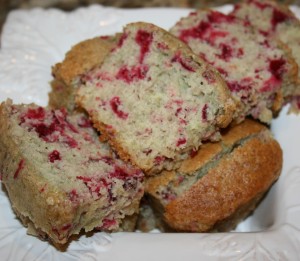
This fruited bread is actually a Thanksgiving tradition in my house. We make multiple loaves and serve it with cream cheese. The combination is tangy, sweet, and unusual. And it is the perfect offering for your book club, as you discuss The Round House by Louise Erdrich.
Cranberry Bread
 Ingredients
- 2 cups flour
- 1 cup sugar
- 1-1/2 teaspoons baking powder
- ½ teaspoon salt
- 2 Tablespoons butter or margarine, room temperature
- ¾ cup orange juice
- 1 egg (beaten)
- 1 cup cranberries, halved
- 1/2 cup chopped walnuts (optional)
Directions
Preheat the oven to 350 degrees.
Slice your cranberries in half and set aside. It helps to cut them frozen and slightly thawed. Or pop them in the freezer for a ½ hour before you plan to cut.
Grease two bread pans.
Mix dry ingredients and toss lightly.
Add butter, orange juice, and egg and stir vigorously until combined.
Once mixed, fold in cranberries (and walnuts, optional).
Pour batter into pan and spread evenly.
Bake at 350 degrees for 40-50 minutes. Insert a toothpick to make sure the centers are cooked and firm. Serve with cream cheese.
Walnuts can be added to this sweet bread for extra texture and crunch. There are few things I look forward to at Thanksgiving more than Cranberry Bread. It makes a simple, delicious addition to your book club discussion of The Round House by Louise Erdrich.
The Round House – Discussion Questions
The Round House is Louise Erdrich’s 26th book and practice has made perfect. Riveting, paradigm-shifting, and expansive, The Round House has won the National Book Award as well as many others. It delves into race, religion, socioeconomics, truth, revenge, and justice. And it makes for a compelling discussion among your next book club meeting.
Book Synopsis
 One Sunday in the spring of 1988, a woman living on a reservation in North Dakota is attacked. The details of the crime are slow to surface as Geraldine Coutts is traumatized and reluctant to relive or reveal what happened, either to the police or to her husband, Bazil, and thirteen-year-old son, Joe. In one day, Joe’s life is irrevocably transformed. He tries to heal his mother, but she will not leave her bed and slips into an abyss of solitude. Increasingly alone, Joe finds himself thrust prematurely into an adult world for which he is ill prepared.
While his father, who is a tribal judge, endeavors to wrest justice from a situation that defies his efforts, Joe becomes frustrated with the official investigation and sets out with his trusted friends, Cappy, Zack, and Angus, to get some answers of his own. Their quest takes them first to the Round House, a sacred space and place of worship for the Ojibwe. And this is only the beginning.
-From the publisher, Harper Collins
Discussion Questions for The Round House
Louise Erdrich’s publisher, Harper Collins, offers a lengthy list of discussion questions. As always, consider these additional questions as well:
- Why do you think the author chose to have Joe narrate the story? How did his perspective color/influence the story?
- How do we struggle with reaching/helping people who are caught in the cycle of grief? Joe can’t reach his mother and force her to resume living. How do we force/or drop the ball on others who need help?
- Can you name an instance when you reached out to help someone struggling? Did it end well or was there an adverse reaction?
- Why do you think Joe’s mother wouldn’t name the place where the rape occurred? Do you think she truly didn’t know or is she keeping quiet? Considering the crime of rape is true, do you think it would be ethical of her to bend the facts on the location?
- Joe is 13 when his mother is raped, which is a pivotal coming of age time for boys. Do you think his actions and reactions would have been different if he had been 8 or 9? What about if he was 18?
- What is your definition of justice? Does perspective, relationship, time, space, etc. affect justice?
- Have you ever sat on a jury? Do you think you are a good judge of character?
- If Joe were to stand trial for the murder of his mother’s rapist, how do you think he would be found? Guilty? Not guilty? How would you vote?
- What’s your opinion on the balance in the universe? His friend had to die at the end, because a death equaled a death. Do you think the universe finds equilibrium?
A few related foods will be will be featured this week, including Cranberry Bread, Faux Steak Res Sandwiches, and Triple Berry Cobbler.
May words nourish your soul.